
Exercise Scientist & Remedial Massage Therapist
Strong Foundation. Infinite Movement.
Hill Yang brings movement science and more than 20 years of hands-on clinical practice to complex, long-standing musculoskeletal presentations and athlete performance care.
The Innovation
Dynamic Myofascial Release (DMFR)
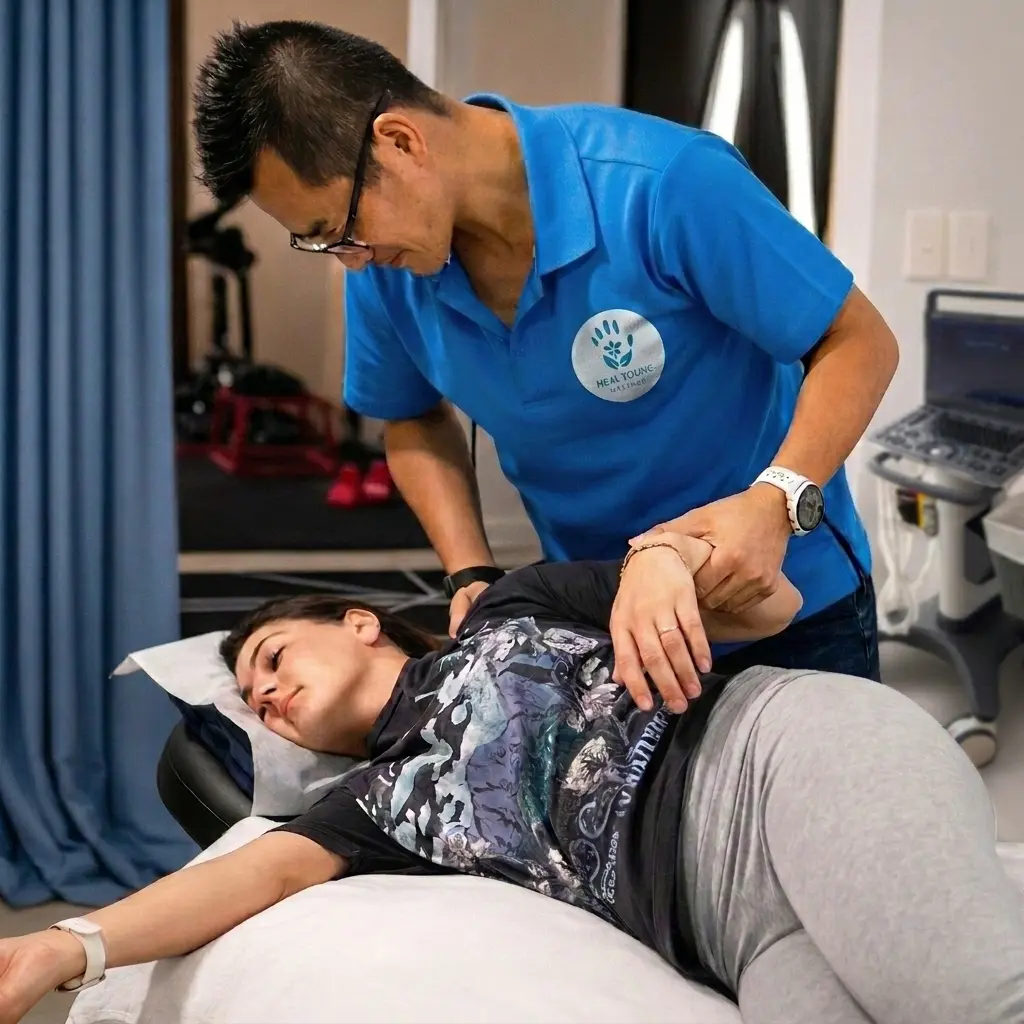
DMFR is hands-on myofascial work applied while you move, not only while you lie still. Developed by Hill in 2015, it combines active movement, guided breathing and real-time feedback, so release work is connected to the way your body actually loads and moves.
DMFR sessions since 2015, refined through high-volume practice across sporting and everyday clinical settings.
Objective Measurement
Measurement adds another layer to hands-on assessment, giving you a clear baseline and a way to track how you move and respond over time.
VALD ForceDecks
Measures ground reaction force and left–right asymmetry during jumps, squats and balance tasks, so change can be tracked session to session.
Movement-Based Ultrasound
Real-time imaging to observe soft tissue and fascial glide during movement. Used to inform hands-on care, not to provide a medical diagnosis.
AxIT Strength Testing
Strength and range-of-motion testing that maps left–right differences to help shape your exercise program.
Exercise Scientist, Gold Coast
From Resilience to Performance
“My journey began with adversity.” Facing significant health challenges as a child, Hill spent his formative years learning how to build physical capacity from the ground up.
Today, he works with athletes aspiring toward LA28 and Brisbane 2032, as well as people living with complex, long-standing presentations who are looking for a different perspective.
ESSA Accredited Exercise Scientist (AES #17005) · Remedial Massage Therapist (MMA #031045)
Information on this site is general and educational only and is not medical advice. Individual results vary. Hill works within the scope of an Accredited Exercise Scientist and Remedial Massage Therapist and does not provide medical diagnosis. For medical concerns, please consult your GP or treating health professional.